
Recruiting takes focus.
Status requests take time.
Pinpoint Hire’s official website describes healthcare recruitment across California, including physicians, advanced-practice providers, nurses, physical therapists, social workers and medical leadership. It lists Santa Rosa as its location and describes direct outreach and market relationships for hard-to-fill roles. That public context does not verify a Neebix relationship or a participating remote team.
Recruiting can involve sourcing, candidate calls, client discussions, interview coordination, market research, offers and recruitment-system administration. Much of that work is valuable without continuous keyboard or mouse input.
The supplied brief describes a management problem: search milestones can show progress, but may leave managers unsure what explains a quiet period. Broad status messages and meetings can then interrupt the same work managers are trying to understand. The actual previous update process, ATS or CRM, team size and working arrangement are not supplied.
Can managers review routine work context before interrupting a recruiter—and use the conversation to resolve a real need?
A stalled search needs an explanation
A quiet pipeline might reflect long candidate calls, a difficult market, a priority change, delayed client feedback, an unrecorded update or a device problem. An online indicator cannot distinguish those situations. The appropriate response depends on the work and the recruiter’s explanation.
Review the record.
Keep recruiting outcomes primary.
The proposed model places a work-context layer around the existing recruiting process. It connects the search outcome, recorded working period, relevant activity and a human explanation when needed.
Recruiting records
Candidates, submissions, interviews, offers, placements and client outcomes in the existing recruiting system.
Work-session evidence
Permitted time records, relevant application context and device connection state.
Agreed expectations
Priority searches, working periods, flexible hours, calls, meetings and work away from the device.
Recruiter and manager context
The explanation of a blocker, recording error, market challenge, changed priority or support need.
What Neebix contributes
Neebix’s public workforce monitoring features describe activity timelines, timesheets, app and website usage, live device status, optional screenshots and reports. These can provide relevant context for an authorized review.
The actual Pinpoint Hire configuration and application classifications remain unconfirmed. This draft does not claim a native ATS integration, automatic search assignment, exception alerts, candidate-quality scoring or placement attribution. Neebix does not replace the ATS, CRM, calling platform or client record in this model.
A category is context, not a verdict
A networking site might support sourcing. A video call might be a candidate interview. A spreadsheet might support market research. A disconnected device may explain a missing record. Confirm the purpose with the person doing the work before interpreting a gap or classification.
Use time tracking vs employee monitoring to distinguish the working period from its interpretation, and employee productivity metrics to keep output, quality and workload in view.
Make the question specific.
Make the conversation useful.
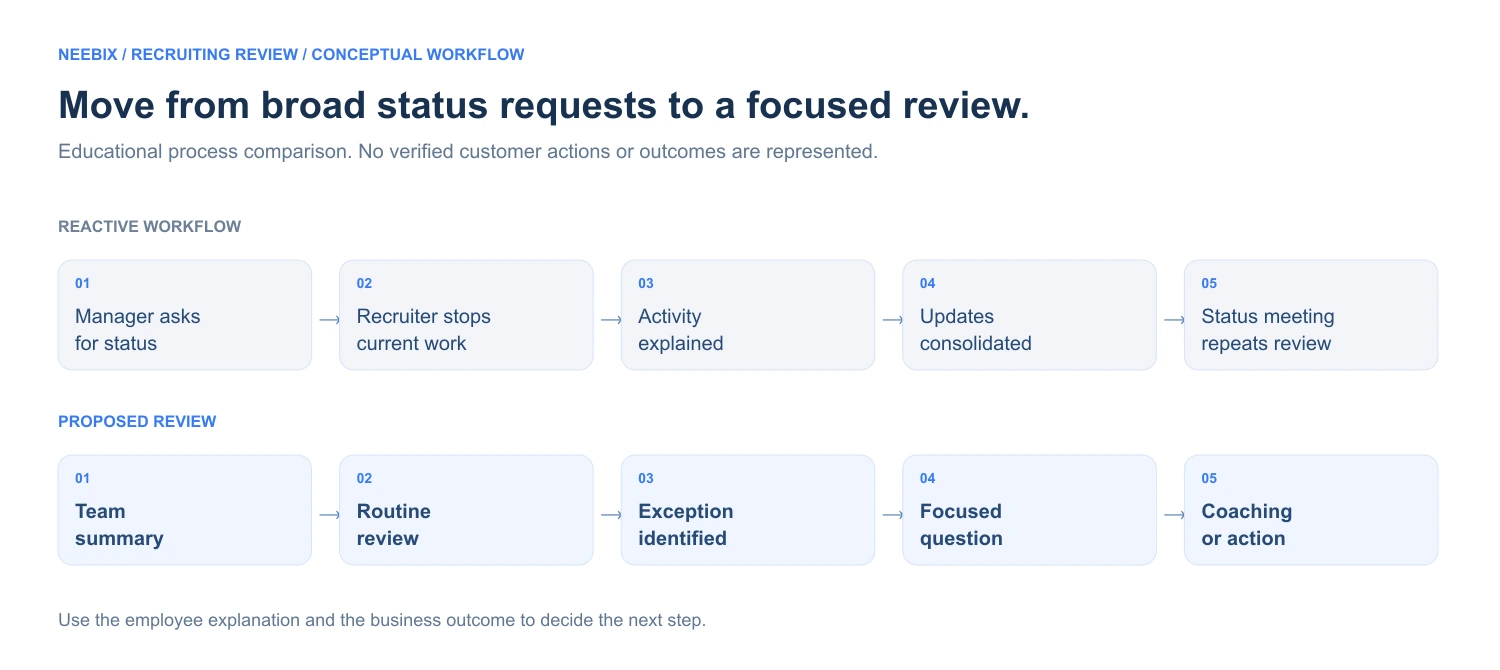
The proposed change is an asynchronous review of routine context followed by a focused conversation when an exception needs explanation. It is an organizational process, not a verified before-and-after customer outcome.
Move from broad status requests to a focused review.
- Manager asks
- Recruiter stops
- Activity explained
- Updates consolidated
- Status meeting
- Team summary
- Routine review
- Exception identified
- Focused question
- Coaching or action
Agree on the recruiting priorities
Define the searches, clients, responsibilities and outcomes that matter for the review period. Monitoring cannot decide which search should take priority.
Record only the agreed work context
Collect permitted sessions, timesheets and relevant activity within the documented work periods. Confirm device scope, access, retention and whether screenshots are enabled.
Review routine information asynchronously
Use the authorized work summary, relevant timeline and device status before requesting another broad update. Check the reliability and completeness of the record.
Compare the context with recruiting outcomes
Use the existing recruiting system for qualified candidates, submissions, interviews, offers and placements. Look for a question worth investigating rather than a conclusion from input activity.
Ask a focused question where needed
Confirm calls, client feedback, research, reprioritization, work away from the device, administrative load and technical interruptions with the recruiter.
Use a conversation for the next decision
Agree whether the issue calls for coaching, search strategy, a client escalation, a tool fix, workload support or a corrected record. Keep useful one-to-ones and wellbeing conversations.
Review interruption and outcome evidence
Measure defined status requests, meeting time, report preparation and recruiter interruptions over comparable periods. Check that recruiting quality, support and employee understanding remain acceptable.
Use work context to narrow the recruiting question.
Recruiting records and permitted work evidence inform a question. The recruiter’s explanation and manager context inform the action.
| Review area | Reactive process | Proposed process |
|---|---|---|
| Routine updates | Request the same broad update from everyone | Review permitted routine records before asking |
| Unclear period | Ask what happened across the whole day | Narrow the question to the relevant work period |
| Recruiter focus | Interrupt sourcing or a call for a status reply | Contact the recruiter when support or clarification is needed |
| Technical issues | Treat a missing record as a work-progress problem | Check device and tracker context first |
| Meetings | Collect basic status information synchronously | Reserve conversation time for decisions and coaching |
| Manager attention | Review everyone in the same depth | Focus on defined exceptions and support needs |
| Performance | Infer success from presence or app activity | Use recruiting outcomes and the employee’s explanation |
| Consistency | Depend on whether the manager asks | Use an agreed review and correction process |
On a small screen, scroll the table or diagrams to see all columns.
Build an exception-based remote-management process.
Start with shared priorities and a permitted work record; keep the recruiter’s explanation in the review.
A work timeline
cannot establish a placement.
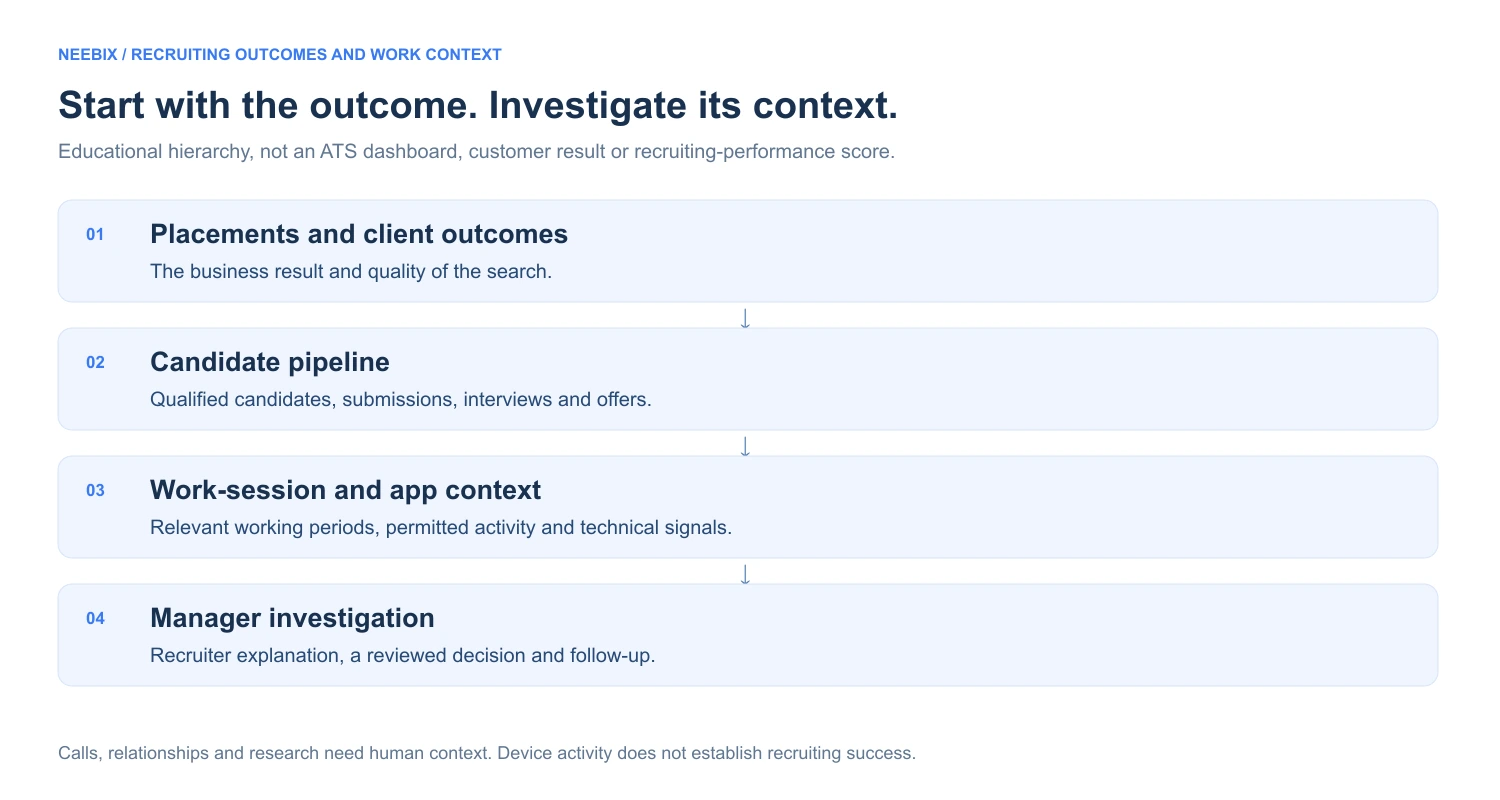
Start with the business outcome, then investigate its context.
- 01
Placements and client outcomes
The result and quality of the search.
- 02
Candidate pipeline
Qualified candidates, submissions, interviews and offers.
- 03
Work-session and app context
Relevant work periods, permitted activity and technical signals.
- 04
Manager investigation
Recruiter explanation, a reviewed decision and follow-up.
Allow for recruiting work beyond the screen
A candidate call, interview, compensation discussion, careful profile review or client conversation can produce little device input. A work-session record can help frame a question, but it cannot prove candidate engagement or quality.
The final story needs the actual recruiting guardrail: qualified candidate flow, response, interviews, offers, placements, time-to-fill, client satisfaction or retention. A lower count of check-ins is useful only if managers still provide adequate support and the agreed recruiting outcome remains acceptable.
Keep coaching and strategy in the workday
Use direct conversations for difficult searches, market insight, client priorities, escalations, career development, wellbeing and feedback. Those conversations should not be reclassified as waste to strengthen a savings claim.
For work-period, permissions and device questions, use the remote employee monitoring software guide. The actual customer work model, time zones and monitoring schedule need confirmation.
Define the interruption.
Measure the change.
The supplied results are placeholders. No customer-approved baseline, comparison period, population or recruiting outcome was supplied. The measures below describe evidence required for the customer edition.
- Routine manager check-ins
- Define the messages, emails, calls or status-only meetings included. Exclude coaching, decisions, necessary support and valuable one-to-ones. Keep baseline and comparison counts for the same population and period length.
- Status-meeting time
- Use calendars or recorded durations. State whether meetings became shorter, less frequent or changed purpose. Distinguish meeting duration from participant-hours.
- Manager administration
- Measure defined requesting, reading, consolidation, device checks and record-reconstruction activities. Identify the time owner and avoid overlap with meeting or report-preparation savings.
- Weekly report preparation
- Compare the same report scope and preparation activities. Separate automatic generation, human interpretation and rollout setup; do not add reporting time twice.
- Exception identification
- Define the event that starts the clock and the verified identification event. Distinguish a work blocker from a device or recording issue.
- Recruiter interruptions and focus
- Use permitted communication records, manager logs or an employee survey with defined questions. Fewer messages cannot be converted into hours without a documented method.
- Recruiting outcome and employee experience
- Keep the approved ATS/CRM guardrail, comparable search mix and recruiting population. Confirm that support, employee understanding, access and correction routes remained acceptable.
- Check-in reduction
- (Baseline routine check-ins − comparison routine check-ins) ÷ baseline routine check-ins × 100
A zero baseline makes the percentage reduction undefined. Normalize for team size, manager changes, period length and search mix where needed. Count overlapping message, meeting and reporting time once; manager-hours and recruiter-hours describe different people’s time.
Check interruption measures against recruiting outcomes.
A reduction in routine status work needs defined records, comparable periods, employee feedback and a recruiting-quality guardrail.
No check-in reduction, saved hours, faster exception detection, placement increase or revenue improvement is claimed in this draft. The approved chronology must separate the contribution of Neebix records from changes in management practice and other tools.

Give the review a purpose.
Protect the recruiting record.
Recruiting records can contain personal and commercial information: candidate contact details, résumés, employment history, compensation expectations, interview notes, client requisitions, offers and private communications.
- Define the included employees and devices, working periods, flexible-hours arrangements and personal-device rules.
- Confirm screenshot settings, frequency, retention and sensitive application exclusions.
- Specify who may view detailed records and who may export them.
- Provide a clear route for employee explanations, corrections and work away from the device.
- Review what, if anything, enters client-facing reporting.
- Protect candidate profiles, messages, calendar participants and identifiable search strings in every export or visual.
The actual customer policy and settings are unconfirmed. Adapt the employee monitoring policy template and review the screenshot monitoring guide against the real implementation.
These editorial images and diagrams contain no recruiting records. A real Neebix demonstration timeline needs a genuine interface with synthetic or explicitly approved data; this page does not substitute a fabricated screenshot.
Keep the expectations clear.
Give conversations a job.
Priorities come before monitoring.
Agree which searches, clients and outcomes matter. A record cannot decide the team’s priorities.
Presence is a limited signal.
A connection indicator does not explain the work or establish the quality of a candidate relationship.
Review exceptions with human context.
Use a relevant period and a focused question. Calls, research and feedback dependencies need explanation.
Keep communication that helps.
Coaching, strategy, wellbeing and difficult decisions remain valuable manager work.
Measure interruption separately from outcomes.
Use defined records and a recruiting guardrail rather than an activity leaderboard or an unsupported time-saved claim.
The intended chain is routine work context → a more precise question → a focused conversation → a reviewed support or priority decision. Reduced interruptions and improved outcomes need separate measurement before publication.
When comparing plans, use the employee monitoring software pricing guide alongside Neebix pricing. Confirm reports, retention, permissions and device coverage; no customer plan is established here.
Explore related stories.
 Operations & Back Office / review draftTransit & Flow: Connecting workflow evidence with capacity decisionsCustomer approval and outcome evidence pending. ↗
 Customer Support & Call Center / review draftLendware: Connecting support coverage with capacity decisionsCustomer approval and outcome evidence pending. ↗
 Agency & Professional Services / review draftSpruce InfoTech: From reviewed project hours to clearer cost decisionsCustomer approval and outcome evidence pending. ↗
 BPO & Outsourcing / review draft3 Link Sales: A clearer record behind every billable hourCustomer approval and outcome evidence pending. ↗